Can I Legally Work Remotely in France for a U.S. Company? 2026 Update for Americans Moving to Paris
You have a U.S. job, your company is happy for you to work remotely, and you are thinking about moving to Paris to live your dream Parisian life.
The plan seems simple: bring your laptop, work from your Paris apartment, and keep your American salary.
But before you book your flight, there are two important questions to answer: how long can you legally stay in France without a visa, and does your visa allow you to work remotely from France?
How Long Can a U.S. Citizen Legally Stay in France Without a Visa?
As a U.S. citizen, you can legally stay in France without a visa for up to 90 days within any rolling 180-day period.
This limit applies to the entire Schengen Area, not just France, so time spent in other Schengen countries counts toward the same 90-day limit.
For stays longer than 90 days, you generally need to apply for a long-stay visa before traveling to France.
Immigration Status and the Right to Work in France
France does not currently offer a dedicated digital nomad visa, so the right visa depends on your nationality, how long you plan to stay, and what kind of work you will actually do from France.
- EU/EEA and Swiss citizens: You can live and work in France without a visa or work permit.
- Long-stay visitor visa (VLS-TS Visiteur): This may be appropriate if you stay in France for more than 90 days while continuing to work remotely for a foreign employer and remaining outside the French labor market
- Entrepreneur / Profession Libérale visa: Allows eligible non-EU nationals to live in France and carry out an authorized self-employed or liberal professional activity.
- Talent or employee visas: If you are hired in France, transferred to a French entity, sent on assignment to a French company, or qualify as a highly skilled employee or business creator, a professional visa or one of France’s Talent residence categories may apply.
We will explain these visa options and requirements in more detail below.
Can You Work Remotely in France on a Visitor Visa (VLS-TS)?
Yes, under certain conditions. You can work remotely from France for a foreign company, such as a U.S. employer, as long as you are not working for a French company or participating in the French labor market.
The VLS-TS Visiteur is a common option for Americans who want to live in France without entering the French labor market. It is commonly used by retirees, people on sabbatical, and those living on savings or other income.
For a long time, the situation for remote workers was less clear. However, on June 23, 2026, the French Ministry of the Interior issued an official response to a parliamentary question specifically addressing remote work under visitor status.
Remote work may be compatible with visitor status (VLS-TS visiteur) if:
- you are not employed in France;
- you are not performing professional activity for a company established in France;
- you work remotely for an employer governed by foreign law;
- you remain outside the French labor market.
You must also meet the usual visitor visa requirements, including sufficient financial resources, accommodation, and health insurance.
France does not currently offer a dedicated digital nomad visa.
What Is Prohibited on a French Visitor Visa (VLS-TS)?
A French visitor visa, including a long-stay visitor visa (VLS-TS), does not authorize you to engage in any local professional or commercial activity on French territory.
You cannot use visitor status to:
- Take a job with a French employer.
- Work for a French company.
- Provide professional services to French clients as part of an activity carried out in the French market.
- Carry out a professional activity in France as an independent contractor.
- Start a business in France.
- Register as a self-employed worker.
- Perform local work in exchange for payment.
The visitor visa is intended for people who want to stay in France for private reasons without engaging in professional activity during their stay.
If your planned activity involves a French employer, French clients, a French business, or services performed for the French market, you may need a different visa or residence status, such as an employee, talent passport, entrepreneur/profession libérale, or other work-authorized status that specifically authorizes that activity.
What Visa or Titre de Séjour Do You Need to Start a Business or Work Freelance in France?
If you plan to move to France to start your own business, work as a freelancer, or provide services to French clients, you generally need a residence status that allows you to carry out a professional activity in France.
- EU, EEA, and Swiss citizens do not need a visa or residence permit to work freelance or start a company in France.
- Non-EU citizens starting a business or working freelance in France generally need an Entrepreneur / Profession Libérale VLS-TS or, if they meet the relevant criteria, a Talent – Business Creator residence route.
The “entrepreneur / profession libérale” residence status
For many freelancers, consultants, and small business owners, one relevant option is the Entrepreneur / Profession Libérale VLS-TS.
It is generally valid for one year and can be renewed from France. You do not need to make a large investment, but you must show that your activity is real and viable. You must also demonstrate sufficient resources at least equivalent to the applicable French full-time minimum wage (SMIC).
This status is generally intended for people who want to:
- create or operate a business in France;
- work as an independent consultant or freelancer;
- provide professional services to French or international clients;
- carry out a self-employed activity from France.
Depending on your situation, your application may require documents such as:
- a business plan or detailed description of your activity;
- evidence of professional qualifications or experience;
- projected income and financial resources;
- proof of accommodation in France;
- information about your expected clients or contracts;
- documents relating to your planned business structure.
The exact requirements can vary depending on your activity and personal situation, so you should check the current instructions from the French consulate responsible for your place of residence.
If You Are Creating a Startup or Innovative Company
If you are launching a startup, creating a business, or developing an innovative project in France, you may qualify for a Talent residence permit, including certain routes linked to the French Tech Visa.
These permits can be valid for up to four years, and eligible family members can generally accompany you.
The exact requirements depend on the category you apply under. For example:
- Talent – Business Creator: you generally need to invest at least €30,000, hold a Master’s degree or have five years of comparable professional experience, and show that your business project is genuine and serious.
- Innovative Economic Project: you generally need recognition from a relevant French public body and proof of sufficient financial resources.
Other Talent categories may also apply to investors, highly qualified employees, researchers, and certain startup founders.
Because each category has its own eligibility rules, it is important to identify the specific Talent route that matches your situation.
Do Remote Workers in France Have to Pay French Taxes?
Yes, you can be legally allowed to live and work remotely in France and still have French tax obligations. Immigration status and tax residency are separate issues.
France may consider you tax resident depending on factors such as where your household or main residence is located, where your principal professional activity is carried out, and where your center of economic interests is located.
So working for a U.S. company and being paid into a U.S. bank account does not automatically mean that you are exempt from French taxes.
At the same time, U.S. citizens generally remain subject to U.S. tax-filing obligations while living abroad. The France-U.S. tax treaty helps determine how income is taxed and can help avoid double taxation.
If you are moving to France long-term, it is advisable to speak with a tax professional familiar with both French and U.S. tax rules.
Working Remotely From France for a U.S. Employer: What Your HR Team Should Know
If your employer is based in the U.S. and your job is remote, you may be able to work from France — but you should not assume that “remote” automatically means “work from anywhere.”
Your company may have its own rules about:
- which countries employees are allowed to work from;
- how many days you can work abroad;
- data security and network access;
- payroll, tax, and social-security compliance.
Your employer may also have obligations in France. As a general rule, social-security contributions are linked to the country where the work is physically performed, although exceptions exist.
For example, if your U.S. employer temporarily assigns you to France, you may be able to remain under the U.S. Social Security system for up to five years, provided you are genuinely sent to France by that employer and the agreement’s conditions are met.
In other cases, your employer may need to register in France and pay French social contributions through URSSAF.
The key point: before deciding to work remotely from France, check with your HR or legal team and make sure the arrangement is approved. Working from Paris is not always treated the same as working remotely from another U.S. state.
How to Rent an Apartment While Working Remotely in Paris?
When applying for a VLS-TS Visiteur visa, you will generally need to provide proof of accommodation in France as part of your application, and once you arrive, you will also need a French residential address when validating your visa online.
So you may be wondering: can you rent an apartment in Paris while you are still in the U.S.?
Yes, absolutely.
Many expats secure their Paris apartment before arriving. The process can simply be easier if you work with a real estate agency that is used to dealing with international tenants and understands how foreign employment and income should be presented to a French landlord.
American remote workers often have strong financial profiles, but their rental applications can look unusual by French standards.
You may earn $120,000 a year, have excellent U.S. credit, significant savings, and have worked for the same company for eight years.
A French landlord, however, may see:
- a foreign employer;
- income paid in U.S. dollars;
- no French payslips;
- no French tax history yet;
- no French guarantor.
None of this means that you cannot rent an apartment in Paris. It simply means that your rental application needs to be well prepared and well presented.
Before starting your search, prepare your employment contract, recent payslips, tax documents, proof of income, recent rent receipts or proof of rent payments, and, if possible, a letter from your previous landlord.
You should also gather any guarantees that can strengthen your application. For foreign applicants, a third-party rental guarantee such as Garantme may be relatively straightforward to arrange and can help reassure the landlord.
At Paris Rental, we regularly work with American expats and other international tenants before they arrive in France. We understand that a strong U.S. rental profile can look very different from a traditional French one, and we help our clients present their application in a way that French landlords can easily understand.
That can make the difference between simply having a good financial profile and having a rental file that a Paris landlord feels comfortable accepting.
Think About Your Home Office Before Choosing an Apartment
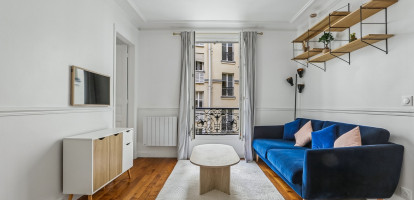
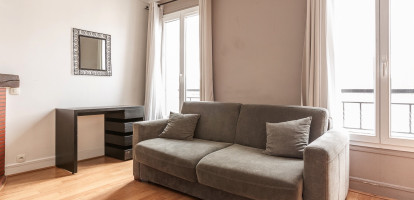
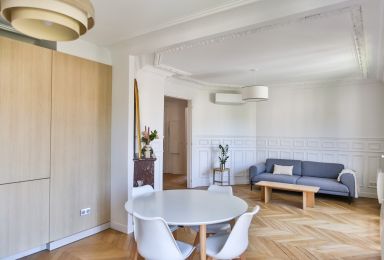
If you're going to work from home several days a week, don't choose your Paris apartment based only on the neighborhood and the view.
Think about what your workday will actually look like.
- Does the apartment have enough room for a real desk and a comfortable office chair?
- Is there enough natural light?
- Is the apartment quiet enough during the day?
- Does the apartment get too hot in summer, and is there air conditioning or good ventilation?
- If two people work remotely, is there enough space for both of you to take calls at the same time?
- If your colleagues are on New York or California time, will your workspace still be comfortable when you're taking calls in the evening?
A charming one-bedroom overlooking a busy Paris street may look perfect during a 10-minute viewing but feel very different after six hours of Zoom meetings.
For remote workers, your apartment is also your workplace, so functionality matters more than it might for someone who commutes every day.
If you work from home regularly, prioritize a quiet bedroom or separate workspace, good natural light, enough room for a proper desk, and ideally a layout that lets you close a door during calls. A slightly less central apartment with more space and better comfort can often be a much better choice than a smaller apartment in the perfect postcard location.
What Are the Best Paris Neighborhoods for Remote Workers?
If you work remotely, the “best” neighborhood is not necessarily the most central one. You will probably spend more time at home than the average commuter, so space, natural light, quiet streets, cafés, coworking options, and overall quality of life matter a lot.
A few areas work particularly well:
- Canal Saint-Martin / 10th arrondissement: lively, creative, and especially good if you like working occasionally from cafés or coworking spaces. The area has plenty of cafés and coworking options around the canal, République, and Gare de l’Est.
- 11th arrondissement / Oberkampf–Bastille: a good choice if you want cafés, restaurants, nightlife, and a younger international atmosphere, while still having plenty of places to work outside your apartment.
- Batignolles / 17th arrondissement: residential but still youthful and lively, with a strong neighborhood feel, parks, cafés, and a growing coworking scene. It can be a very good compromise if you want a bit more separation between work and nightlife.
- 14th arrondissement / Alésia–Pernety: quieter and less touristy, with a more residential feel and good coworking options around Montparnasse and Alésia. This can be a good fit for remote workers who prioritize calm and a little more space.
- Saint-Germain-des-Prés or the Marais: excellent if you want to be in the heart of Paris and enjoy walking everywhere, but you will usually pay more for less space. For someone working from home full-time, that trade-off is worth thinking about carefully.
The most important thing is to choose according to how you actually work. If you spend eight hours a day at home, a bright two-bedroom in the 14th or 17th may suit you much better than a small one-bedroom in Saint-Germain. If you like alternating between home, cafés, and coworking spaces, the 10th or 11th may be a better fit.
That is also why finding the right apartment in Paris is about more than choosing an arrondissement. At Paris Rental, we help international tenants find long-term furnished and unfurnished apartments that match their budget, lifestyle, and way of working, while also guiding them through the practical side of renting in France with a foreign employment profile.