Living in Le Marais, Paris: A Complete Expat Guide
For many expats moving to Paris, Le Marais is exactly what they imagined Paris would feel like.
Narrow streets, old stone buildings, hidden courtyards, cafés spilling onto the sidewalk, independent boutiques, galleries, bakeries, museums, and the Seine just a few minutes away.
It is historic, cultural, stylish, central, and full of life.
But living in Le Marais is quite different from spending a Saturday afternoon there.
Here is our complete Parisian guide to living in Le Marais, from the best streets and local atmosphere to rental prices, transport, architecture, and the practical things to know before moving in.
Where Exactly Is Le Marais Located in Paris?
One thing that can confuse newcomers is that Le Marais is not an official arrondissement. The neighborhood stretches across parts of the 3rd and 4th arrondissements, roughly between Hôtel de Ville, République, Bastille, and the Seine.
Its name comes from the area’s history: marais means “marsh” in French, and parts of the neighborhood developed on former marshland.
Today, Le Marais includes several areas with very different atmospheres: the elegant streets around Place des Vosges and Saint-Paul, the busy shopping streets around Rue des Francs-Bourgeois, the historic Jewish quarter around Rue des Rosiers, and the more local northern Marais around Rue de Bretagne and Marché des Enfants Rouges.
What Makes Le Marais So Unique? The History of Le Marais
Le Marais is one of the best-preserved historic neighborhoods in Paris and also one of the most popular areas among expats.
From the 16th century, and especially during the 17th century, aristocratic families built grand private mansions — known as hôtels particuliers — throughout the neighborhood. Many of these buildings still exist today and are a defining part of Le Marais.
Over time, the Marais changed considerably and became home to craftspeople, workers, Jewish communities, and successive waves of residents. By the 20th century, parts of Le Marais had deteriorated enough that large-scale demolition was considered.
The neighborhood was ultimately protected through the Malraux heritage law of 1962, which helped preserve its historic architecture.
Today, that layered history is still visible everywhere. Within a few streets, you can find aristocratic mansions, synagogues, Jewish bakeries, galleries, fashion boutiques, museums, a long-established Chinese and Asian community around Arts et Métiers, and one of Paris’s best-known LGBTQ+ areas.
This combination of history, central location, lively atmosphere, and international character is also one of the reasons Le Marais is so attractive to expats living in Paris.
What Type of Architecture Is Found in Le Marais, Paris?
If you are expecting classic Haussmannian Paris everywhere, Le Marais may surprise you.
Much of the neighborhood developed before the major Haussmann renovations of the 19th century, which is why its streets and buildings feel very different from many other parts of Paris.
You can find several architectural layers throughout Le Marais:
- Medieval buildings — including some 14th- and 15th-century half-timbered and gabled houses;
- 17th-century hôtels particuliers — grand private mansions built for aristocratic families, often with hidden courtyards, stone façades, and classical French details;
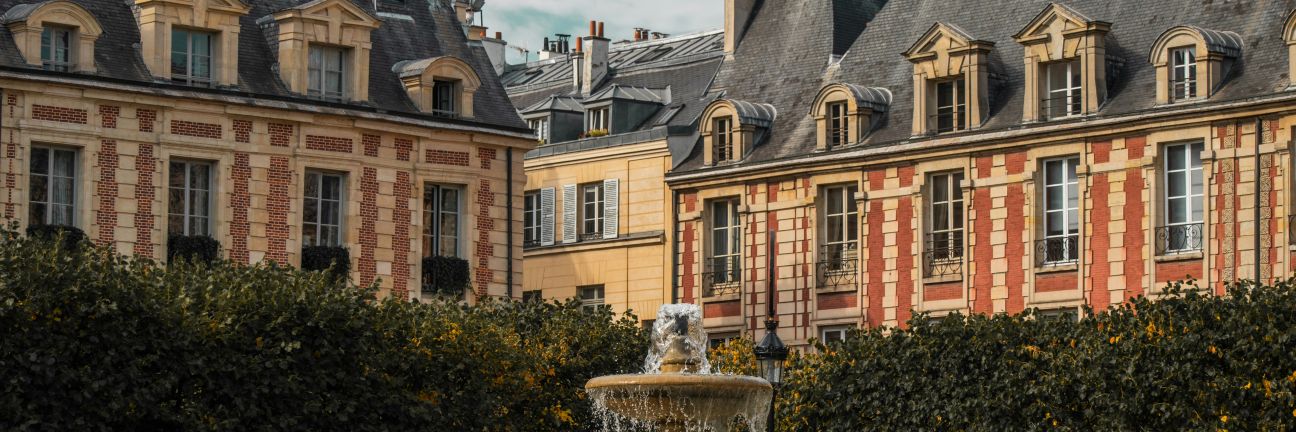
- Place des Vosges architecture — known for its red brick, pale stone, arcades, and slate roofs;
- 17th- and 18th-century classical and Baroque details;
- pre-Haussmann streetscapes — narrow streets, irregular plots, and buildings with very different proportions from the wide boulevards found elsewhere in Paris.
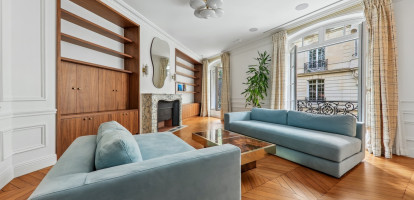
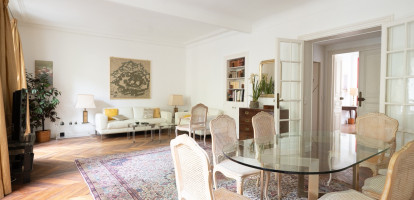
Inside the apartments, you may also find beautiful historic features such as:
- exposed wooden beams;
- high ceilings;
- original parquet or terracotta floors;
- fireplaces;
- old stone walls and interior courtyards.
What Are the Advantages of Living in Le Marais?
Le Marais Is One of the Most Walkable Neighborhoods in Paris
Le Marais is extremely central and connects easily with several surrounding areas, including the 1st, 2nd, 5th, 6th, 10th, 11th, and 12th arrondissements.
Depending on where you live, you can walk easily to:
- the Seine;
- Île Saint-Louis;
- Notre-Dame;
- Hôtel de Ville;
- Bastille;
- République;
- Canal Saint Martin;
- the Centre Pompidou;
- Saint-Germain-des-Prés across the river;
- Latin Quarter.
You can pick up groceries, meet friends for coffee, visit a museum, go shopping, walk along the Seine, have dinner or drinks, and get home without needing a car, public transportation, or an Uber.
For expats arriving from more car-dependent cities, especially in the U.S., this can completely change the way you experience daily life in Paris.
Le Marais Is Very Well Connected by Public Transportation
Le Marais is very well connected, with several metro lines running through or around the neighborhood. Depending on where you live, you can use:
- Line 1 from Saint-Paul or Hôtel de Ville, with direct access to Châtelet, the Louvre, Concorde, and La Défense;
- Line 3 from Arts et Métiers, Temple, or République, useful for Opéra and the Saint-Lazare area;
- Line 5 from République or Bastille, convenient for Gare du Nord and Gare de l’Est;
- Line 8 from Chemin Vert, République, or Bastille;
- Line 9 from République;
- Line 11 from Rambuteau, Hôtel de Ville, Arts et Métiers, or République, with quick access to Châtelet and eastern Paris.
You are also close to major transport hubs such as Châtelet, République, and Bastille, making it easy to commute across Paris or connect with other metro and RER lines.
Le Marais Is One of the Best Neighborhoods in Paris for Culture
Culture is part of everyday life in Le Marais.
The neighborhood is home to major museums such as the Musée Picasso, the Musée Carnavalet, and the Maison de Victor Hugo, as well as many smaller galleries, photography spaces, design shops, and cultural venues.
You are also close to the Centre Pompidou building in Beaubourg, although the museum itself is currently closed for major renovations until 2030.
For expats who enjoy art, history, design, or architecture, living in Le Marais means having a large part of Paris’s cultural scene within walking distance.
Le Marais Is One of the Best Neighborhoods in Paris for Food Lovers
Le Marais is also one of the best parts of Paris for food lovers. You will find everything from traditional French bakeries, wine bars, bistros, and cheese shops to kosher restaurants, falafel spots, international food stalls, trendy cafés, and contemporary restaurants.
It is a neighborhood where eating well can easily become part of everyday life.
Le Marais Is One of the Best Areas in Paris for Shopping
Le Marais is also one of the best areas for shopping in Paris, and it feels very different from spending the afternoon in a big department store.
You can move from a small French fashion label to a vintage shop, a perfume boutique, or a design store within just a few streets. Around Rue des Francs-Bourgeois, Rue Vieille du Temple, Rue des Archives, and Rue des Rosiers, there is always something new to discover.
The northern Marais (Upper Marais) has a slightly different feel, with more independent boutiques, concept stores, and creative brands mixed in with cafés and neighborhood shops.
For people who enjoy fashion and design, one of the nicest things about living in Le Marais is that shopping simply becomes part of walking around the neighborhood.
Le Marais Is One of the Liveliest Areas of Paris on Sundays
One thing that surprises many newcomers is how lively Le Marais can be on Sundays.
Contrary to the image of Paris as a city where everything shuts down at the end of the week, many shops, cafés, restaurants, and boutiques in Le Marais remain open on Sundays, especially around the main shopping streets.
For expats who are used to living in cities that feel active 24/7, this is a real advantage — and very convenient. For others, especially those looking for a quieter residential atmosphere, it may be less appealing.
Le Marais Is Very Expat-Friendly
Le Marais is one of the most popular neighborhoods among international residents, which also makes it relatively easy for expats to settle into.
If your French is still limited when you arrive, you will generally find the neighborhood easy to navigate. Many shops, cafés, restaurants, and local businesses are used to welcoming international customers, and English is commonly spoken.
What Are the Downsides of Living in Le Marais?
Le Marais is one of Paris’s most desirable neighborhoods, but it is not perfect for everyone. Before renting an apartment here, there are a few practical trade-offs to keep in mind.
Le Marais Is Expensive
Le Marais is one of the most expensive parts of Paris, both to buy and to rent.
As of September 2026, SeLoger estimates average apartment sale prices at around €11,923/m² in the 3rd arrondissement and €12,544/m² in the 4th, compared with around €9,827/m² across Paris.
Rents are also high, especially for well-renovated furnished apartments. As a general guide, you can expect:
- Studio: around €1,300–€1,800/month;
- 1-bedroom apartment: around €1,800–€2,600/month;
- 2-bedroom apartment: around €2,700–€4,000+/month;
- Larger or premium apartments: often €4,000–€6,000+ per month.
Properties on sought-after streets, as well as apartments with a terrace, elevator, air conditioning, exceptional historic features, or a beautiful view, can cost considerably more.
In Le Marais, you are often paying not only for the apartment itself, but also for the location, architecture, and lifestyle of the neighborhood.
Some Streets in Le Marais Can Be Very Busy and Noisy
Le Marais attracts both Parisians and visitors throughout the week, especially around Rue des Francs-Bourgeois, Rue des Rosiers, Rue Vieille du Temple, Rue Sainte-Croix de la Bretonnerie, and parts of Rue du Temple.
Restaurants, bars, terraces, deliveries, scooters, and people walking home late at night can all add to the noise.
This is why the exact street and the way the apartment faces really matter. A flat overlooking a quiet courtyard can feel surprisingly peaceful, while one facing a busy street may be much noisier, especially in the evening and on weekends.
Historic Apartments Can Come With Practical Trade-Offs
One of the charms of living in Le Marais is the historic architecture, but older buildings do not always offer the same level of comfort as more modern apartments.
Many properties date back to the 16th, 17th, and 18th centuries, and even beautifully renovated apartments can still come with a few practical limitations:
- no elevator;
- several flights of stairs;
- narrow staircases;
- smaller kitchens and bathrooms;
- irregular layouts;
- limited storage;
- less sound insulation;
- older plumbing or electrical systems;
- restrictions on installing air conditioning.
Balconies, terraces, and private gardens are also relatively rare in Le Marais, especially in older buildings. Properties with a good-sized terrace or garden do exist, but they are usually much harder to find and considerably more expensive.
If you are looking for a long-term rental in Le Marais, it is worth checking more than just the interior design. Elevator access, layout, sound insulation, storage, outdoor space, and the overall condition of the building can make a big difference to everyday comfort.
Parking Is Limited and Driving Can Be Complicated
Le Marais is not the easiest neighborhood if you use a car regularly.
Since November 2024, the 3rd and 4th arrondissements have been part of Paris’s Limited Traffic Zone (ZTL). Cars can still enter the area, but through-traffic is restricted, which makes driving across the neighborhood less straightforward.
Parking can also be difficult. Many historic buildings do not have private parking, street spaces are limited, and renting a nearby parking spot can be expensive. Narrow streets, one-way systems, pedestrian areas, and delivery traffic can make driving in and out even more frustrating.
For most residents, walking, cycling, and public transportation are simply more practical. If you need a car every day, especially to commute outside Paris, Le Marais may be less convenient than more residential neighborhoods with easier road access and parking.
Le Marais Is Not the Most Family-Friendly Neighborhood
Le Marais can be a great place to live, but it is not always the most practical choice for families with young children.
Many streets are narrow, sidewalks can feel crowded, and getting around with a stroller is not always easy, especially on busy weekends. Apartments are also often smaller, and larger family-sized homes can be difficult and expensive to find.
The neighborhood has some lovely squares and small gardens, but large parks, playgrounds, and open green spaces are limited compared with more residential parts of Paris.
For families looking for more space, quieter streets, easier stroller access, and more outdoor areas nearby, neighborhoods in the 15th, 16th, or 17th arrondissements may be more practical.
Some Parts of Le Marais Can Feel Very Touristy
Le Marais is one of the most visited parts of Paris, so some areas can feel crowded, especially on weekends. Streets around Rue des Rosiers, Rue des Francs-Bourgeois, Rue Vieille du Temple, and Place des Vosges are often busy with shoppers, visitors, and restaurant queues.
If you prefer a quieter atmosphere, look beyond the main shopping streets. Parts of the northern 3rd arrondissement, especially around smaller streets near Rue de Bretagne and Arts et Métiers, can feel more local and residential.
Best Streets to Live in Le Marais, Paris
In Le Marais, the exact street can matter almost as much as the apartment itself.
Two apartments just a few minutes apart can offer very different lifestyles — one quiet and residential, the other lively and busy throughout the day.
Place des Vosges: Historic and Prestigious
For many people, Place des Vosges is the dream address in Le Marais.
It is elegant, historic, and instantly recognizable, with its red-brick façades, arcades, central garden, galleries, and cafés. Apartments around Place des Vosges can also have exceptional historic features, including high ceilings, fireplaces, parquet or terracotta floors, and exposed or painted beams.
But living on the square is not only about the architecture. It is also about the prestige and exclusivity of the address itself.
The main challenge is availability. Rental supply is extremely limited, and apartments overlooking the square can command a significant premium.
Rue de Turenne: Fashionable but More Residential
Rue de Turenne is a good choice if you want to stay in the heart of Le Marais without living directly on one of its busiest shopping streets.
The street mixes art galleries, concept stores, fashion boutiques, cafés, and residential buildings, while keeping you close to Place des Vosges, Marché des Enfants Rouges, and the Upper Marais.
The street also has strong links to Paris’s fashion and creative scene, so it becomes noticeably busier during Fashion Week.
What makes Rue de Turenne interesting for everyday life is that the atmosphere changes as you walk along it. Some parts of Rue de Turenne are busy and energetic, while others feel noticeably calmer and more residential, making it particularly attractive for long-term living in Le Marais.
Rue Vieille du Temple: In the Heart of Le Marais
Rue Vieille du Temple is one of the streets that best represents Le Marais, both for its atmosphere and its history.
Its name dates back to the medieval period and refers to the Knights Templar, who once had important possessions in this part of Paris. The street developed long before the Haussmann renovations, which helps explain its narrow layout, historic façades, inner courtyards, and mix of buildings from different periods.
Today, Rue Vieille du Temple crosses both the 3rd and 4th arrondissements, and its atmosphere changes as you move north.
Closer to Rue de Rivoli, the street feels busier and more commercial. Further north, toward Rue de Bretagne, it becomes a little more local and residential.
It is a great choice if you want to feel immersed in the history and everyday life of Le Marais. The only thing to watch is noise: if the apartment faces the street, especially near the livelier sections, it is worth checking how it feels in the evening and on weekends.
Rue de Sévigné: Elegant and Slightly Quieter
Rue de Sévigné is a great option if you want to stay in the heart of Le Marais without being right on one of its busiest streets.
You are just a few minutes from Place des Vosges, Musée Carnavalet, and Saint-Paul, but the atmosphere feels a little calmer and more residential. The street is lined with beautiful historic buildings and has a more understated feel than the main shopping areas nearby.
Rue des Francs-Bourgeois: Lively and Fashionable
Rue des Francs-Bourgeois is one of the best-known streets in Le Marais and one of the best streets for shopping in Paris.
The street combines beautiful historic architecture with a strong fashion and lifestyle scene. You will find fashion boutiques, perfume brands, and design stores set among impressive 17th-century buildings, including the Hôtel de Soubise, the Hôtel de Rohan, and the Hôtel d’Albret.
It is stylish and full of energy, but also very busy, especially on weekends.
If you like the energy of the street, it can be a great place to live. If you are sensitive to noise, it might not be the best option for you.
Rue des Rosiers: Historic and Full of Character
Rue des Rosiers is one of the most distinctive streets in Le Marais and the historic heart of the neighborhood’s Jewish quarter.
Jewish communities have lived in this part of Paris for centuries, and the area became especially associated with Jewish life from the 19th century onward, as families from Eastern Europe settled in the neighborhood. That history is still visible today in its kosher bakeries, food shops, bookshops, synagogues, and restaurants.
Over time, fashion boutiques and more contemporary stores have moved in, creating the mix of old and new that gives Rue des Rosiers its very particular atmosphere.
The rhythm of the street also changes depending on the day. Some traditional businesses close for Shabbat on Saturday, while Sundays are often especially lively.
It is a street full of history, character, and energy — but also one that can feel very busy, particularly at weekends.
Rue de Bretagne: A More Local Neighborhood Feel
Rue de Bretagne has a more neighborhood feel than the busiest parts of the southern Marais.
The street is lined with cafés, food shops, galleries, and independent boutiques, and it is home to the Marché des Enfants Rouges, Paris’s oldest covered market, dating back to 1615. Today, the market is especially popular for its wide range of food stalls serving cuisines from around the world.
The atmosphere is lively, but still more relaxed and everyday — which makes Rue de Bretagne especially appealing for long-term living.
Rue du Bourg-Tibourg: Charming and Extremely Central
Rue du Bourg-Tibourg is a small, picturesque street right in the heart of the southern Marais.
It is close to Hôtel de Ville and Rue de Rivoli, but feels more intimate than the larger streets nearby. You will find cafés, boutiques, and beautiful historic façades within a very compact area.
It has all the advantages of a very central Marais address, but also the usual trade-offs: few apartments available, high rents, and a lively atmosphere outside.
How Much Does It Cost to Rent an Apartment in Le Marais in 2026?
Le Marais sits at the expensive end of the Paris rental market.
For international tenants looking for good-quality furnished apartment rentals in Le Marais, realistic monthly budgets are often closer to:
- Studio €1,400–€2,000+
- 1-bedroom €1,900–€3,000+
- 2-bedroom €3,200–€5,000+
- premium €5,000–€10,000+.
When looking for an apartment for rent in Le Marais, the price is not determined by size alone. The exact street, floor, elevator, natural light, air conditioning, terrace, courtyard view, historic features, and quality of the renovation can all have a major impact on the rent.
How Much Does It Cost to Buy an Apartment in Le Marais?
Buying an apartment in Le Marais comes at a clear premium compared with the rest of Paris.
As of September 2026, Seloger estimates the average apartment price at approximately:
- €11,923/m² in Paris 3rd;
- €12,544/m² in Paris 4th.
For comparison, the Paris-wide average is around €9,827/m².
However, prices vary quite a lot within Le Marais.
The southern and most prestigious parts of the neighborhood, particularly around Saint-Gervais, Archives, Place des Vosges and Saint-Paul, tend to be among the most expensive, at around €12,980/m².
The northern part of the 3rd arrondissement, around République and Arts et Métiers, can be slightly more affordable, at around €11,170/m², although it is still expensive by Paris standards.
Iconic Places to Visit in Le Marais
One of the pleasures of living in Le Marais is that places visitors travel across Paris to see become part of your everyday surroundings.
Place des Vosges
Place des Vosges is probably the neighborhood's most iconic address.
Originally called Place Royale, it dates from the early 17th century and is one of Paris's oldest monumental squares. Its red-brick façades, arcades, symmetrical buildings, and central garden make it completely different from the typical Haussmannian Paris people often imagine.
Victor Hugo lived on Place des Vosges, and his former home is now a museum. Even if you are not a huge literature fan, the location itself makes it worth knowing if you live nearby.
If you live nearby, go early in the morning. Before the tourists and picnics arrive, it feels incredibly calm.
Musée Carnavalet
Musée Carnavalet is one of those places that is especially nice to have nearby when you live in Paris.
Dedicated to the history of Paris, it tells the story of the city through paintings, historic interiors, old shop signs, objects, documents, and everyday pieces from different periods.
The permanent collection is free, so you can easily stop by for an hour without planning a full museum day.
The setting is also part of the experience. In the museum’s courtyard garden, there is a café-restaurant where you can sit outside for a coffee, a drink, lunch, or dinner — a lovely spot for a break in the middle of Le Marais.
Marché des Enfants Rouges
In the northern Marais, the Marché des Enfants Rouges is one of those places that works just as well for locals as it does for visitors.
Founded in 1615, it is the oldest covered food market in Paris. Today, it mixes traditional market stalls with a very international food scene. You can find French produce, cheese, meat, fish, organic fruit and vegetables, as well as food stands serving Moroccan couscous, Japanese home-style dishes, Lebanese specialties, Italian food, African and Afro-Caribbean cuisine, Breton galettes, oysters, and more.
If you live nearby, it can easily become part of your weekly routine — whether for groceries, lunch, a quick coffee, or something to eat with friends.
The LGBTQ+ Side of Le Marais
Le Marais has been closely associated with Paris’s LGBTQ+ community since the late 1970s and 1980s, when gay bars, clubs, cafés, bookstores, and other businesses began concentrating in the neighborhood.
The area around Rue des Archives, Rue Sainte-Croix de la Bretonnerie, and Rue Vieille du Temple gradually became one of the main centers of LGBTQ+ life in Paris.
Over the decades, Le Marais became known as one of the city’s most visible and welcoming LGBTQ+ neighborhoods, with nightlife, independent businesses, cultural venues, and community organizations all contributing to that identity.
The neighborhood is also closely linked to Paris Pride (Marche des Fiertés), with many bars, businesses, and associations in the area taking part in the celebrations and events around Pride each year.
Hidden Gems and Quiet Places in Le Marais
The famous streets get most of the attention, but some of the best parts of Le Marais are easy to walk past.
Hôtel de Sully
Just off Rue Saint-Antoine, the Hôtel de Sully is one of the most beautiful historic mansions in Le Marais.
Built in the early 17th century, it reflects the period when wealthy aristocratic families were settling in the neighborhood and building grand hôtels particuliers around private courtyards and gardens.
Behind its fairly discreet entrance, you can walk through elegant courtyards and a garden, then continue almost directly toward Place des Vosges.
Jardin des Rosiers – Joseph-Migneret
Hidden behind the busy streets of the Jewish quarter, the Jardin des Rosiers – Joseph-Migneret is one of those places you could easily miss if you did not know it was there.
The garden was created by linking together several former private gardens behind historic buildings in Le Marais, which explains its unusual, tucked-away layout.
Despite being only a few steps from the busy Rue des Rosiers, it feels surprisingly quiet. It is a lovely place to sit for a few minutes, read, or take a break from the busier streets nearby.
Village Saint-Paul
Toward the Seine, Village Saint-Paul is a quieter corner of Le Marais made up of small connected courtyards and passages.
The area developed around the old Philippe Auguste city wall, and you can still feel that older, more tucked-away side of the neighborhood as you walk through it.
Today, it is known for its antique dealers, galleries, design shops, and decorative arts stores, with far less foot traffic than the main shopping streets.
It feels almost like a little village hidden inside Le Marais.
Square Saint-Gilles Grand Veneur
The Square Saint-Gilles Grand Veneur is one of those tiny gardens that is very easy to walk past without noticing.
Tucked away near Rue de Turenne and surrounded by historic buildings, it feels surprisingly peaceful compared with the busier streets nearby.
It is a lovely place to sit with a coffee, read for a while, or simply take a quiet break from the crowds. In a neighborhood as lively as Le Marais, it is the kind of little spot that gives you a few moments of calm without leaving the area.
Is Le Marais Good for Families?
It can be.
Families who prioritize central location, culture, walkability, and access to schools may love it.
That said, there are some trade-offs: larger apartments are relatively rare and expensive, many historic buildings have very small elevators or none at all, storage and outdoor space can be limited, and some streets are simply too busy for families looking for a quiet residential atmosphere.
For families needing three or four bedrooms, parking, a large elevator, and more modern amenities, the 15th, 16th, or 17th arrondissement may offer more practical options. But for a smaller family that wants to live right in the center of Paris, the quieter parts of the 3rd arrondissement can be a very good fit.
At Paris Rental, we have been helping international tenants, companies, and embassies find long-term rentals in Paris since 1987.
We regularly assist expats and international professionals looking for a furnished or unfurnished apartment in Le Marais, in Paris’s 3rd and 4th arrondissements.
Our role is not just to show you apartments. We also help you understand what living at that address will actually feel like day to day — from the street and noise level to transport, building access, and the overall neighborhood atmosphere.